Decide what to do next.
RelationalAI combines predictive reasoning with enterprise context so forecasts and predictions can account for the customers, products, assets, relationships, and conditions they describe—and become inputs to better decisions.
Hear AT&T and RelationalAI discuss specialized AI, autonomous networks, and using business context to optimize decisions across complex network environments.


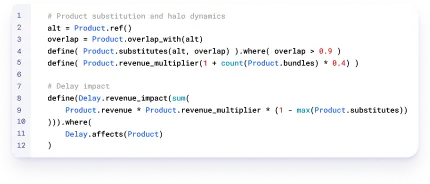
1# Product substitution and halo dynamics
2alt = Product.ref ()
3overlap = Product.overlap_with(alt)
4define( Product.substitutes(alt, overlap) ) where ( overlap > 0.9 )
5define( Product. revenue_multiplier(1 + count (Product.bundles) * 0.4))
6
7# Delay impact
8define(Delay.revenue_impact(sum(
9Product. revenue * Product. revenue_multiplier * (1 - max(Product.substitutes))
10))). where (
11Delay.affects(Product)
12)
What should we buy, sell, or hedge?
What should we markdown, replenish, or reallocate?
Which intervention should happen next?
Inventory, capital, capacity, people, and infrastructure are constrained. RelationalAI brings forecasts, business objectives, policies, and operational constraints together to evaluate trade-offs and determine how resources should be allocated.
The same connected intelligence can answer questions across the enterprise.
Determine how to allocate inventory, capital, capacity, workforce, or infrastructure across competing needs.
inventory allocation • capital allocation • network capacity • workforce planning
Evaluate trade-offs across cost, revenue, risk, service levels, availability, and other business goals.
portfolio optimization • network investment • pricing • supply planning
Re-evaluate decisions as demand, supply, capacity, forecasts, policies, or priorities change.
portfolio optimization • network investment • pricing • supply planning
Rebalance a portfolio against expected return, risk, tax, currency exposure, and investment constraints.
Re-evaluate network capacity and investment as demand, service levels, infrastructure constraints, and operating conditions change.
Allocate limited inventory across stores, customers, and channels based on demand, supply, service commitments, and margin.
Blue Yonder uses RelationalAI to bring semantic understanding and reasoning to supply-chain decisions—helping customers anticipate disruptions, adapt plans, and optimize decisions while reducing the complexity of the underlying application.
Make complex policy executable
Business rules rarely exist in isolation. Eligibility, regulatory requirements, contractual obligations, thresholds, and exceptions depend on the entities and relationships involved. RelationalAI represents that logic alongside enterprise context so it can be applied consistently to each situation.

Which relationships and transactions require investigation?
Which services or programs are available in this situation?
Which programs or services is this case eligible for?
1# Product substitution and halo dynamics
2alt = Product.ref ()
3overlap = Product.overlap_with(alt)
4define( Product.substitutes(alt, overlap) ) where ( overlap > 0.9 )
5define( Product. revenue_multiplier(1 + count (Product.bundles) * 0.4))
6
7# Delay impact
8define(Delay.revenue_impact(sum(
9Product. revenue * Product. revenue_multiplier * (1 - max(Product.substitutes))
10))). where (
11Delay.affects(Product)
12)Know what’s likely to happen next.
RelationalAI combines predictive reasoning with enterprise context so forecasts and predictions can account for the customers, products, assets, relationships, and conditions they describe—and become inputs to better decisions.
Flow from producing predictions to using them in the context of the business.
Predict future outcomes using enterprise data and the context surrounding what is being predicted.
Demand forecasting • churn prediction • network performance • risk forecasting
Connect predictions to the entities, relationships, and business conditions that help explain what is likely to happen.
Churn drivers • demand signals • risk factors • operational dependencies
Combine predicted outcomes with rules, objectives, and constraints to determine what the business should do next.
Inventory planning • retention actions • capacity planning • risk mitigation
Anticipate operational demand in the context of locations, services, staffing, schedules, and available capacity to help teams prepare resources.
Locations • services • expected demand • staffing • schedules • capacity • resource availability
Anticipate network conditions using demand, utilization, infrastructure, service, and operational context so teams can plan interventions before performance deteriorates.
Sites • assets • topology • utilization • traffic • capacity • service levels • customers
Anticipate demand and supply conditions in the context of products, locations, inventory, suppliers, lead times, promotions, and other operational factors.
Products • locations • demand • inventory • suppliers • lead times • promotions • capacity
A supplier delay, counterparty failure, network outage, or suspicious transaction can propagate across thousands of connected entities. RelationalAI models those relationships in a shared ontology and uses graph reasoning to trace exposure, dependencies, and downstream impact.
What should we buy, sell, or hedge?
What should we markdown, replenish, or reallocate?
Which intervention should happen next?
1# Product substitution and halo dynamics
2alt = Product.ref ()
3overlap = Product.overlap_with(alt)
4define( Product.substitutes(alt, overlap) ) where ( overlap > 0.9 )
5define( Product. revenue_multiplier(1 + count (Product.bundles) * 0.4))
6
7# Delay impact
8define(Delay.revenue_impact(sum(
9Product. revenue * Product. revenue_multiplier * (1 - max(Product.substitutes))
10))). where (
11Delay.affects(Product)
12) Give AI a working model of your business.
Enterprise AI needs more than access to data. RelationalAI gives agents and models a governed understanding of business concepts, relationships, policies, and constraints; specialized tools for complex reasoning; and a way to learn enterprise semantics and reasoning patterns over time.
Flow from producing predictions to using them in the context of the business.
Ground AI in a shared understanding of the entities, relationships, terminology, policies, and constraints that define the business.
Business semantics • enterprise relationships • policies & rules • operational context
Equip AI with specialized reasoning capabilities for problems that require more than general-purpose model reasoning.
Graph traversal • rules evaluation • prediction • optimization
Teach models enterprise semantics, terminology, schemas, and reasoning patterns so they don't have to reconstruct that knowledge at inference time.
Enterprise semantics • schema understanding • reasoning trajectories • model specialization

An Ontology Management System creates, governs, executes on, and evolves a shared model of how your enterprise works.
With it, we connect semantics, relationships, rules, predictions, constraints, and decision logic in one Snowflake-native solution for Decision Intelligence.
©2026 RelationalAI. All rights reserved.