
Company Photo
Company Photo
Location image.
243, Sydney Ave New South Wales
Green light and blur.
RelationalAI Ontology Management System

What is an Ontology Management System?

What it is & what it does

An Ontology Management System creates, governs, executes, and evolves a shared model of how your enterprise works, bringing context, specialized reasoning, and AI learning together in one Snowflake-native system for Decision Intelligence.

Why it matters

The same model can be reasoned over and reused by AI agents, applications, analytics, and operational workflows without moving your data.

One system, all the layers  

RelationalAI bridges semantics, reasoning, and post-training together in one data-to-decision Ontology Management System.
Each layer builds on the knowledge and capabilities of the layers before it, creating an executable model that becomes progressively richer—and more capable of supporting decisions and AI.
DATA
Tables, views, and enterprise data—in Snowflake, where it already lives.
Snowflake-native environment
RelationalAI runs as a Snowflake Native App, bringing modeling and reasoning directly to enterprise data within the Snowflake perimeter.
Snowflake Native App • PyRel • Native App SQL API
Work with existing Snowflake data and governance without moving data into a separate graph or decision system.
Run reasoning workloads using horizontally scalable compute designed around Snowflake's cloud architecture.
RelationalAI—evaluated alongside 16 other vendors— has the only platform built as a Snowflake Data Cloud-native Decision Intelligence Platform in the inaugural Gartner® 2026 Magic Quadrant™ for Decision Intelligence Platforms. read more >
SEMANTICS
What the business means.
Concepts • definitions • metrics • requirements • relationships
RelationalAI creates a governed semantic model so people, applications, and AI share the same understanding of enterprise data.
Modeler • PyRel • Model repository
Model concepts, definitions, metrics, requirements, and relationships.
The semantic model becomes the foundation for richer enterprise knowledge and reasoning in the layers that follow.
RelationalAI is a launch partner to Apache Ossie (incubating), formerly the Open Semantic Interchange, the vendor-neutral standard for exchanging business semantics across platforms. read more >
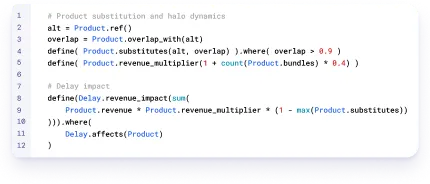
1# Product substitution and halo dynamics
2alt = Product.ref ()
3overlap = Product.overlap_with(alt)
4define( Product.substitutes(alt, overlap) ) where ( overlap > 0.9 )
5define( Product. revenue_multiplier(1 + count (Product.bundles) * 0.4))
6
7# Delay impact
8define(Delay.revenue_impact(sum(
9Product. revenue * Product. revenue_multiplier * (1 - max(Product.substitutes))
10))). where (
11Delay.affects(Product)
12)
(most Semantic-layer products stop here).
ONTOLOGY
How the business works.
(most ontology and knowledge graph
products stop here).
Business entities • relationships • policies • hierarchies • constraints • dependencies
RelationalAI extends the semantic model into an executable representation of how the business works.
Relational Knowledge Graph • Modeler • PyRel • Ontology management
Connect customers, products, accounts, transactions, assets, suppliers, policies, hierarchies, constraints, and dependencies in a governed relational knowledge graph.
Make enterprise knowledge queryable, versionable, governable, and reusable across decisions, applications, and agents.
An open, executable ontology. Represented relationally, governed through Snowflake, and queryable through familiar interfaces for downstream applications.
REASONING
What follows from what we know.
Graph • rules • predictive • prescriptive
RelationalAI adds multiple reasoning capabilities to the same enterprise model—combining database, graph, logic, machine learning, and optimization techniques in a relational architecture designed to scale horizontally.
Graph Reasoner • Rules Reasoner • Predictive Reasoner • Prescriptive Reasoner
Understand connected risk & impact with graph reasoning. Discover relationships, dependencies, paths, communities, and connected impact.
Apply complex policy with rules-based reasoning.
Infer consistently from business rules, policies, requirements, and constraints.
Anticipate outcomes with predictive reasoning.
Generate predictions from relational enterprise data.
Plan & optimize with prescriptive reasoning.
Solve decision problems against objectives and real-world constraints.
Multiple reasoning engines, one model. Relationships, rules, predictions, objectives, and constraints can be reasoned over together rather than fragmented across point tools.
1# Product substitution and halo dynamics
2alt = Product.ref ()
3overlap = Product.overlap_with(alt)
4define( Product.substitutes(alt, overlap) ) where ( overlap > 0.9 )
5define( Product. revenue_multiplier(1 + count (Product.bundles) * 0.4))
6
7# Delay impact
8define(Delay.revenue_impact(sum(
9Product. revenue * Product. revenue_multiplier * (1 - max(Product.substitutes))
10))). where (
11Delay.affects(Product)
12)
(most reasoning tools stop at one).
DECISIONING
What should happen next.
Agents • applications • APIs • Snowflake Intelligence • workflows
The ontology and reasoners become a shared decision foundation for Rel and other AI agents, applications, analytics, and operational workflows.
Rel • Agent skills • APIs • Snowflake Intelligence integrations
Give agents persistent business context and access to specialized reasoning instead of recreating enterprise logic in every prompt or application.
Put decisions to work through Rel, custom agents, enterprise applications, Snowflake Intelligence, APIs, and existing workflows.
Rel, RelationalAI's own decision agent,is built on the same ontology and reasoning capabilities available across the platform. explore Rel >
POST-TRAINING
What AI learns for next time.
Enterprise semantics • reasoning trajectories • model weights
RelationalAI uses enterprise data and semantics to specialize open-weight LLMs for the structures, terminology, and reasoning patterns of the business.
Relational Post-training • Superalignment • ScalarLM
Superalignment combines database-aware techniques including schema linking, data profiling, query consistency, and inference-time reasoning.
Post-training moves enterprise semantics and successful reasoning patterns into model weights, reducing how much context and inference must be reconstructed at runtime.
64.35%
‍
Spider 2.0 Snow
read more >
93.40%
‍
BIRD-SQL dev
1# Product substitution and halo dynamics
2alt = Product.ref ()
3overlap = Product.overlap_with(alt)
4define( Product.substitutes(alt, overlap) ) where ( overlap > 0.9 )
5define( Product. revenue_multiplier(1 + count (Product.bundles) * 0.4))
6
7# Delay impact
8define(Delay.revenue_impact(sum(
9Product. revenue * Product. revenue_multiplier * (1 - max(Product.substitutes))
10))). where (
11Delay.affects(Product)
12)

Different from the start

Expressive

Model more of how the business actually works.

‍
Represent concepts, relationships, hierarchies, rules, policies, constraints, predictions, and optimization objectives in a shared enterprise model.

· patented tech
Scalable

Reason over enterprise-scale data.

‍
RelationalAI's relational architecture brings graph and advanced reasoning workloads to the scale of the cloud data platform.
‍

· 2026 MQ for DI
Open

Your enterprise knowledge isn't in a proprietary silo.

Governed and queryable through familiar interfaces. Our work with the Open Semantic Interchange helps advance portable, vendor-neutral enterprise semantics.

· Apache Ossie contributor
Simple operations

Intelligence to the data, not the other way around.

‍
RelationalAI runs natively in Snowflake, allowing enterprise knowledge and reasoning to operate where governed data already lives.
‍

three circles icon
· Snowflake Native App

One model, many solutions

Connected risk & impact

Traverse relationships and dependencies across the ontology to understand exposure and downstream impact.

Planning & optimization

Evaluate objectives and constraints across the enterprise model to determine how resources should be allocated.

Policy, risk & compliance

Apply business rules, requirements, and exceptions consistently using the context represented in the ontology.

Predictive intelligence

Predict outcomes using enterprise data while keeping those predictions connected to the business context they describe.

Next-best action

Bring relationships, rules, predictions, objectives, and constraints together to determine the appropriate action for a specific situation.

Enterprise AI

Give agents and models access to governed enterprise context, specialized reasoning tools, and learned enterprise knowledge.

explore solutions >
50%
TCO 
reduction
22x
reduction
in application code
300M
edges processed
per production graph
Seconds
for global CPG product-impact model
to answer cross-system questions
(reduced from analyst-days)
read case study >
Build the model your decisions can run on.
Get in touch
Start building