There are moments in your career when different chapters serendipitously converge. For me, seeing RelationalAI featured in the Thoughtworks Technology Radar is one of those moments. Having served on the Technology Advisory Board that creates the Radar, I know firsthand how rigorous and practitioner-driven this process is. So seeing my current company earn a place in the latest edition carries a significance that is both professional and deeply personal.
The Technology Radar is a twice-yearly publication from Thoughtworks that captures an opinionated snapshot of tools, techniques, platforms, and frameworks shaping the technology landscape. What makes it different from typical analyst reports is its foundation: the Radar is built entirely on the real-world experiences of Thoughtworks engineers and practitioners working with many clients across industries.
The Technology Advisory Board is a group of senior technologists at Thoughtworks who meets regularly to discuss global technology strategy and the trends significantly impacting the industry. Critically, vendors cannot influence inclusion. A technology only appears on the Radar if the teams and practitioners on the ground have actually used it and can speak to their direct experience.
The Radar organizes technologies into four rings that indicate maturity and recommended adoption posture:
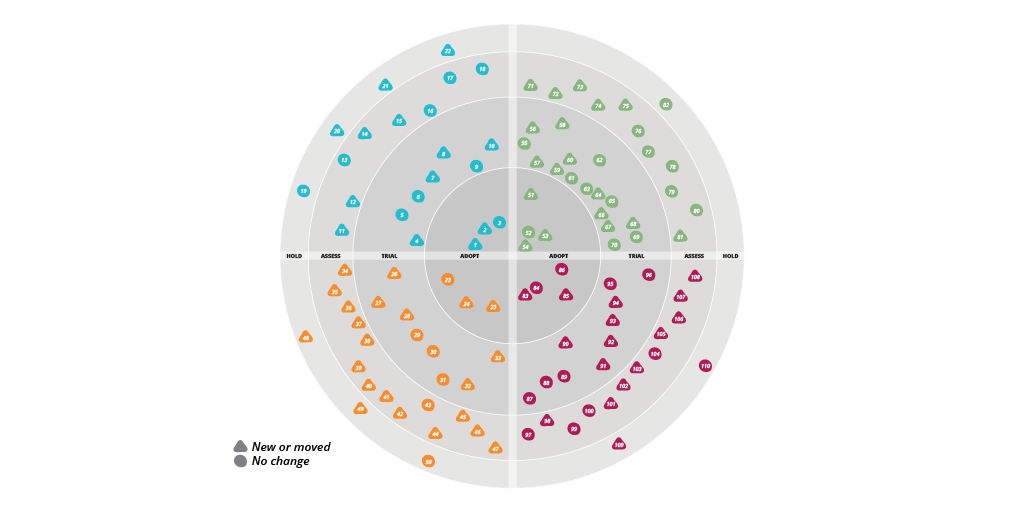
In Volume 33 of the Technology Radar (November 2025), RelationalAI earned a place in the Trial ring within the Tools quadrant. For technologists evaluating the platform, this designation carries real weight: it means Thoughtworkers have deployed RelationalAI on actual client projects, seen its value, and believe it is worth exploring further.
Here's what the Radar entry highlights:
"When large volumes of diverse data are brought into Snowflake, the inherent relationships and implicit rules within that data can become obscured. Built as a Snowflake Native App, RelationalAI enables teams to build sophisticated models that capture meaningful concepts, define core business entities and embed complex logic directly against Snowflake tables. Its powerful Graph Reasoner allows users to then create, analyze and visualize relational knowledge graphs based on these models. Built-in algorithms help explore graph structures and reveal hidden patterns. For organizations managing massive, fast-changing data sets, constructing a knowledge graph can be essential for proactive monitoring and generating richer and more actionable insights."
This description captures exactly the problem space we are focused on: as enterprise data volumes grow and become more interconnected, traditional approaches struggle to surface the relationships and business logic buried within. RelationalAI's decision intelligence within knowledge graphs built within Snowflake provides a path forward.
For companies evaluating knowledge graph technologies, the Tech Radar placement offers independent validation from practitioners who have implemented it in real environments. The Trial quadrant specifically signals that this technology is ready for production use on projects where teams can invest in building the capability.
The Radar's emphasis on RelationalAI as a Snowflake Native App is particularly relevant for organizations already invested in the Snowflake ecosystem. Rather than introducing yet another data silo or requiring complex data movement, RelationalAI operates directly where the data already lives and embedding knowledge graph capabilities into existing data infrastructure.
This aligns with the broader industry trajectory we are seeing: the convergence of AI capabilities with existing data platforms. As Rachel Laycock, Thoughtworks CTO, noted in the Volume 33 announcement, this year has been "a live experiment in AI and we're now beginning to see benefits." Knowledge graphs represent a critical piece of that puzzle, providing the semantic layer that helps AI systems understand business context rather than just process raw data.
This recognition reinforces what we are building at RelationalAI: enabling organizations to build decision agents and intelligence applications that understand business semantics, reason over complex data, and drive high-stakes decisions with confidence. The Radar entry specifically calls out use cases like proactive monitoring and generating actionable insights which is exactly where we shine.
For me personally, seeing these two chapters of my professional journey, my time on Technology Advisory Board and my current work at RelationalAI, come together in this way is a reminder of why practitioner-driven evaluation matters. The Radar has always held a special place in my heart because it represents something rare in our industry: an objective, experience-based guide built on what actually works in the field.
We are excited to continue building on this momentum and helping more organizations unlock the value of knowledge graphs natively within Snowflake.
***
RelationalAI brings frontier decision intelligence natively into Snowflake's AI Data Cloud. Powered by superaligned LLMs, semantic models based on relational knowledge graphs, and advanced reasoners, RelationalAI enables organizations to build decision agents and intelligence applications that understand business semantics, reason over complex data, and drive high-stakes decisions—all without moving data. Learn more at relational.ai.
RelationalAI on the Technology Radar
Thoughtworks Technology Radar Volume 33

Rel is a decision agent aligned to your business, grounded in your semantic model, and powered by the advanced reasoners of the RelationalAI decision intelligence platform.
©2026 RelationalAI. All rights reserved.