Model how your business works. Reason over enterprise knowledge.
Operationalize decisions across AI agents, applications and workflows.



18 cells at risk; 6 already >80% load. Rebalance to sectors A/B and cap video to 720p in ZIPs 76112–76120. Predicted drop in call‑failures: −67%.
Set floor at $14.20; revenue +8.3%, under‑delivery risk 1.1%. If $15.00, revenue +10.6% but breach risk 6.4% in weeks 47–48.
12 lots at risk; median shortfall 7%. Two levers: lower reserve by 3–5% (+$610k sell‑through) or boost bidder liquidity in TX/AB via targeted email to 4,200 lookalikes (+$480k).









Three issues stand between general-purpose AI and enterprise decision intelligence.

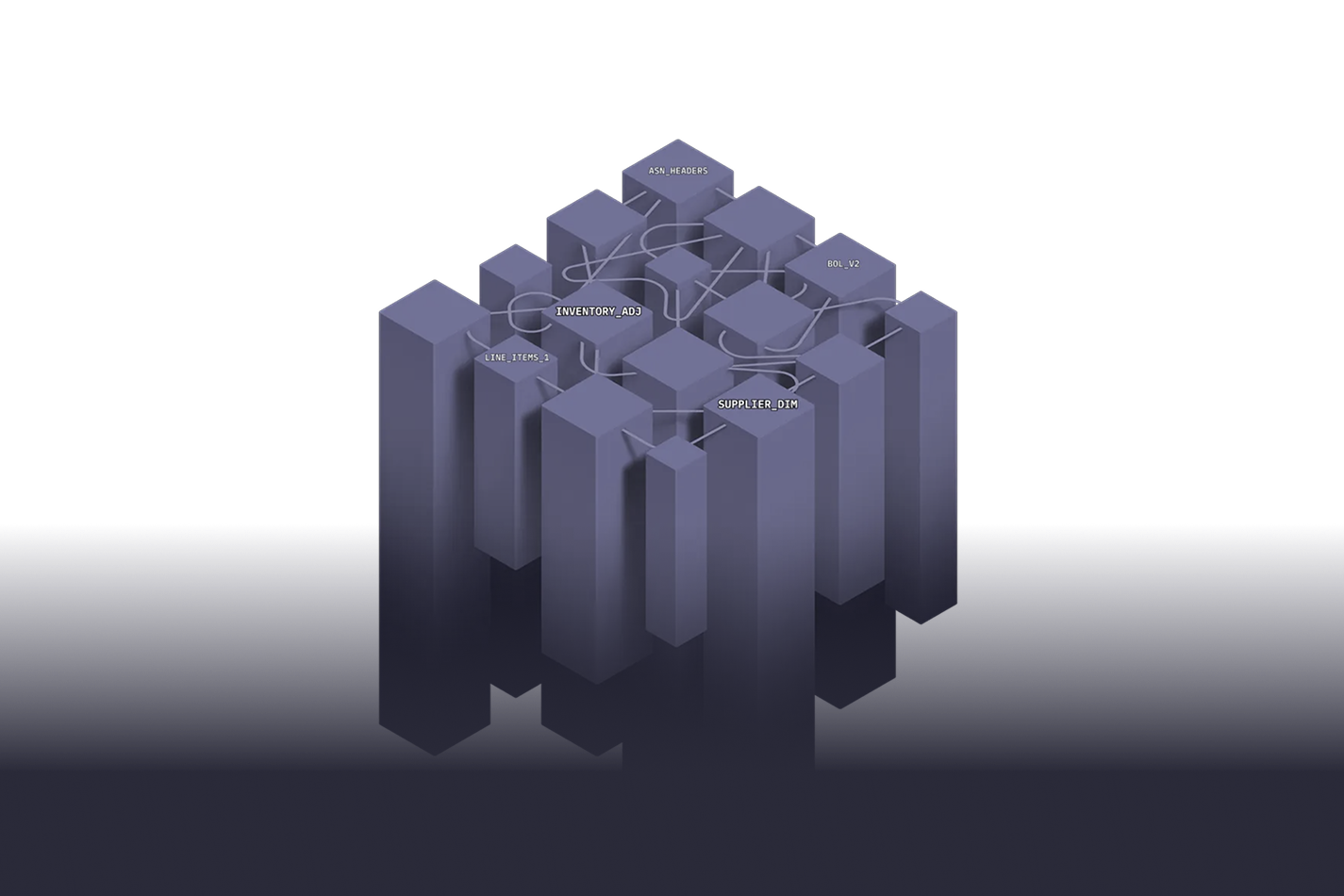


Tracks inventory levels, movements, and status across facilities, enabling accurate stock management, allocation, and valuation for both raw materials and finished products.
1.98K records • Last updated 2 minutes ago


Customers and accounts
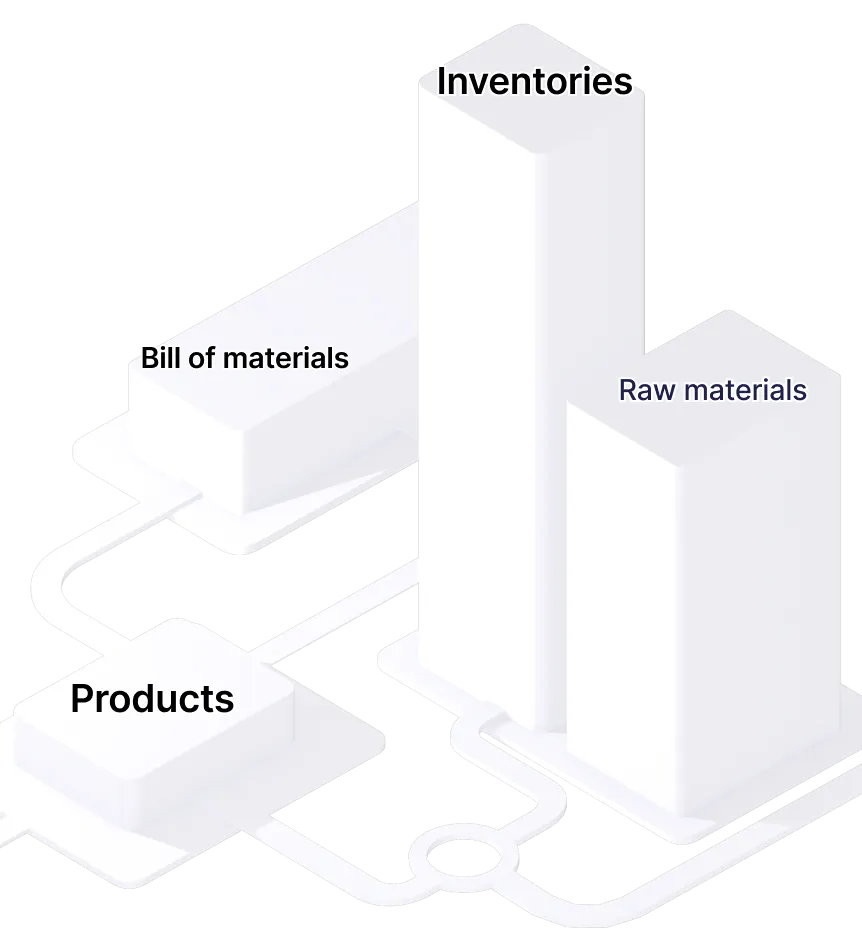
Products and services
Orders and transactions
Suppliers and partners
Assets and locations
Contracts and commitments
Organizational structures
Relationships and dependencies
1.98K records • Last updated 2 minutes ago

Business rules and policies
Eligibility requirements
Operational constraints
Financial targets
Risk thresholds
Forecasts and predictions
Resource and capacity limits
Optimization objectives
304.3K records • Last updated 3 minutes ago


Core manufacturing data structure that defines the components and quantities needed to build a finished product, enabling accurate inventory planning and cost calculations.
833 records • Last updated 3 minutes ago


MODEL
Represent how the business works.
Define business concepts, relationships, properties, requirements, rules and derived knowledge in a shared semantic model.
REASON
Apply intelligence to the model.
Use graph, rules-based, predictive and prescriptive reasoning to understand relationships, apply business logic, predict outcomes and solve decision problems.
OPERATIONALIZE
Put decisions to work.
Make enterprise knowledge and reasoning available to applications, AI agents and downstream tools.

Find communities, paths, dependencies, similarity and structure across connected data.

Encode business logic and derive new knowledge from existing facts.

Train and apply models to predict classifications and outcomes.

Define decision variables, objectives and constraints, then solve for an action.



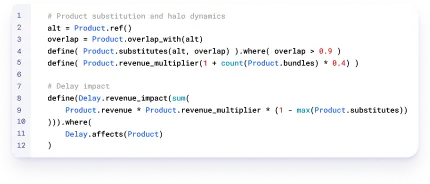
1# Product substitution and halo dynamics
2alt = Product.ref ()
3overlap = Product.overlap_with(alt)
4define( Product.substitutes(alt, overlap) ) where ( overlap > 0.9 )
5define( Product. revenue_multiplier(1 + count (Product.bundles) * 0.4))
6
7# Delay impact
8define(Delay.revenue_impact(sum(
9Product. revenue * Product. revenue_multiplier * (1 - max(Product.substitutes))
10))). where (
11Delay.affects(Product)
12)
1# Product substitution and halo dynamics
2alt = Product.ref ()
3overlap = Product.overlap_with(alt)
4define( Product.substitutes(alt, overlap) ) where ( overlap > 0.9 )
5define( Product. revenue_multiplier(1 + count (Product.bundles) * 0.4))
6
7# Delay impact
8define(Delay.revenue_impact(sum(
9Product. revenue * Product. revenue_multiplier * (1 - max(Product.substitutes))
10))). where (
11Delay.affects(Product)
12)Understand dependencies, exposure and downstream effects across complex enterprise networks.
Allocate scarce resources across objectives, forecasts, policies and constraints.
Connect customer context, behavior, economics and policy to pricing, retention and next-best actions.
Coordinate inventory, capacity, assets and people against changing business conditions.
Reason across entities, transactions, relationships, policy and risk signals.
Give agents governed enterprise knowledge and reasoning capabilities.


Rel is a decision agent aligned to your business, grounded in your semantic model, and powered by the advanced reasoners of the RelationalAI decision intelligence platform.
©2026 RelationalAI. All rights reserved.