Having a coherent map of your entire business means two things:

You can get answers and make decisions grounded in your semantic model.
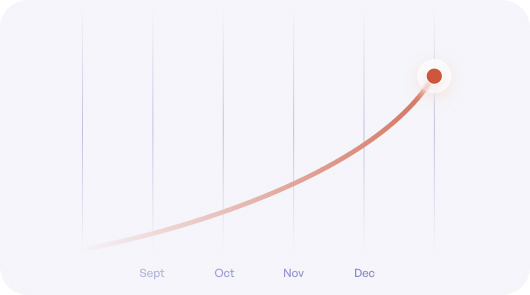
The model isn’t static — every adjustment becomes knowledge that continuously aligns Rel to the realities of your business.

We call this “superalignment.”
Rel teaches LLMs what they
can’t learn on the web.

Built for enterprise knowledge

Model
Represent how the business works.
Model relationships and business logic.
Run reasoning through the RelationalAI Native App inside the Snowflake perimeter.
Apply advanced reasoning to enterprise-scale data and decision workloads.
Snowflake-
Native
Governed & secure
Extend governed enterprise data into governed business knowledge and decision logic.
Run reasoning through the RelationalAI Native App inside the Snowflake perimeter.
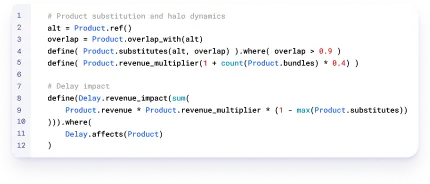
1# Product substitution and halo dynamics
2alt = Product.ref ()
3overlap = Product.overlap_with(alt)
4define( Product.substitutes(alt, overlap) ) where ( overlap > 0.9 )
5define( Product. revenue_multiplier(1 + count (Product.bundles) * 0.4))
6
7# Delay impact
8define(Delay.revenue_impact(sum(
9Product. revenue * Product. revenue_multiplier * (1 - max(Product.substitutes))
10))). where (
11Delay.affects(Product)
12)
Open
Keep enterprise knowledge accessible
across data, applications and AI.
AI-ready
Keep enterprise knowledge accessible across data, applications and AI.
Identify Shanghai supplier's holiday SKUs and volumes
Calculate one-week delay impact on delivery dates
Assess warehouse inventory coverage during gap
Compute lost sales from stockouts
Done
1# Product substitution and halo dynamics
2alt = Product.ref ()
3overlap = Product.overlap_with(alt)
4define( Product.substitutes(alt, overlap) ) where ( overlap > 0.9 )
5define( Product. revenue_multiplier(1 + count (Product.bundles) * 0.4))
6
7# Delay impact
8define(Delay.revenue_impact(sum(
9Product. revenue * Product. revenue_multiplier * (1 - max(Product.substitutes))
10))). where (
11Delay.affects(Product)
12)

And intelligence compounds.

The first use case creates business knowledge that the next one can reuse.
A product model becomes the foundation for supply-chain decisions.
A customer model extends into retention, pricing and fraud.
A network model extends into capacity, service assurance and revenue optimization.

A one-week delay from Shanghai-Acme affects 12 holiday SKUs totaling $3.2M in projected revenue.

Critical finding:
• Your hero product GIFT-001 (wireless earbuds) drives 40% of gift bundle sales through halo effect. When it's out of stock, customers abandon entire baskets—they won't accept GIFT-002 (wired earbuds) despite 85% feature overlap.

Total impact escalates to $1.4M lost revenue, not just the $840K in direct stockouts.

Consider expediting GIFT-001 via air freight ($45K cost) to preserve the $560K in bundle revenue.

Can now drive a
high-stakes decision.
Same question
asked again...

Decisions worth changing

Connected risk & impact

Understand dependencies, exposure and downstream effects across complex enterprise networks.

Planning &
optimization

Allocate scarce resources across objectives, forecasts, policies and constraints.

Customer & commercial intelligence

Connect customer context, behavior, economics and policy to pricing, retention and next-best actions.

Operations & resource allocation

Coordinate inventory, capacity, assets and people against changing business conditions.

Fraud, risk &
compliance

Reason across entities, transactions, relationships, policy and risk signals.

Enterprise
AI

Give agents governed enterprise knowledge and reasoning capabilities.

To minimize my tariff exposure, how should I distribute my part orders across my suppliers?
Minimized costs is optimization.
Discover the shortest paths in
our supply chain.
We use rules to apply tariff regulations and infer their impact.
Anticipate customer demand.

saved for design- do not

Expressive - Executable -
Scalable
End-to-end Decision Intelligence
Model relationships and business logic.
Run reasoning through the RelationalAI Native App inside the Snowflake perimeter.
Apply advanced reasoning to enterprise-scale data and decision workloads.
Snowflake-
Native
Governed & secure
Extend governed enterprise data into governed business knowledge and decision logic.
Run reasoning through the RelationalAI Native App inside the Snowflake perimeter.
1# Product substitution and halo dynamics
2alt = Product.ref ()
3overlap = Product.overlap_with(alt)
4define( Product.substitutes(alt, overlap) ) where ( overlap > 0.9 )
5define( Product. revenue_multiplier(1 + count (Product.bundles) * 0.4))
6
7# Delay impact
8define(Delay.revenue_impact(sum(
9Product. revenue * Product. revenue_multiplier * (1 - max(Product.substitutes))
10))). where (
11Delay.affects(Product)
12)
Open
Keep enterprise knowledge accessible
across data, applications and AI.
AI-ready
Keep enterprise knowledge accessible across data, applications and AI.
Identify Shanghai supplier's holiday SKUs and volumes
Calculate one-week delay impact on delivery dates
Assess warehouse inventory coverage during gap
Compute lost sales from stockouts
Done
1# Product substitution and halo dynamics
2alt = Product.ref ()
3overlap = Product.overlap_with(alt)
4define( Product.substitutes(alt, overlap) ) where ( overlap > 0.9 )
5define( Product. revenue_multiplier(1 + count (Product.bundles) * 0.4))
6
7# Delay impact
8define(Delay.revenue_impact(sum(
9Product. revenue * Product. revenue_multiplier * (1 - max(Product.substitutes))
10))). where (
11Delay.affects(Product)
12)

And intelligence compounds.

The first use case creates business knowledge that the next one can reuse.
A product model becomes the foundation for supply-chain decisions.
A customer model extends into retention, pricing and fraud.
A network model extends into capacity, service assurance and revenue optimization.
What’s the impact on holiday sales if shipments by our Shanghai supplier are delayed one week?
Analyzed holiday impact in four steps
Identify Shanghai supplier's holiday SKUs and volumes
Calculate one-week delay impact on delivery dates
Assess warehouse inventory coverage during gap
Map product substitution patterns and cannibalization rates
Calculate halo effect losses from hero product stockouts
Compute total revenue impact including substitution failures
Done

A one-week delay from Shanghai-Acme affects 12 holiday SKUs totaling $3.2M in projected revenue.

Critical finding:
• Your hero product GIFT-001 (wireless earbuds) drives 40% of gift bundle sales through halo effect. When it's out of stock, customers abandon entire baskets—they won't accept GIFT-002 (wired earbuds) despite 85% feature overlap.

Total impact escalates to $1.4M lost revenue, not just the $840K in direct stockouts.

Consider expediting GIFT-001 via air freight ($45K cost) to preserve the $560K in bundle revenue.

Can now drive a
high-stakes decision.
Same question
asked again...
Extend governed enterprise data into governed business knowledge and decision logic.
Run reasoning through the RelationalAI Native App inside the Snowflake perimeter.
Done

One ontology. Many forms of reasoning.

Graph
reasoning

Find communities, paths, dependencies, similarity and structure across connected data.

with graph reasoning
Pathfinding in preview
Rules-based reasoning

Encode business logic and derive new knowledge from existing facts.

with rules-based reasoning
Predictive
analytics

Train and apply models to predict classifications and outcomes.

with predictive reasoning
Early access
Prescriptive &
optimization

Define decision variables, objectives and constraints, then solve for an action.

with prescriptive reasoning
three circles icon
Early access
Decisions can start with deceptively simple questions.
How should I price my smartphone accessories to maximize my profit in Q2?
Maximizing profit
means optimizing.
Infer profit from your explicit rules.
We need to anticipate how elastic prices can be.
To minimize my tariff exposure, how should I distribute my part orders across my suppliers?
Minimized costs is optimization.
Discover the shortest paths in
our supply chain.
We use rules to apply tariff regulations and infer their impact.
Anticipate customer demand.

One ontology. Many forms of reasoning.

Graph
reasoning

Find communities, paths, dependencies, similarity and structure across connected data.

with graph reasoning
Pathfinding in preview
Rules-based reasoning

Encode business logic and derive new knowledge from existing facts.

with rules-based reasoning
Predictive
analytics

Train and apply models to predict classifications and outcomes.

with predictive reasoning
Early access
Prescriptive &
optimization

Define decision variables, objectives and constraints, then solve for an action.

with prescriptive reasoning
three circles icon
Early access
Decisions can start with deceptively simple questions.
How should I price my smartphone accessories to maximize my profit in Q2?
Maximizing profit
means optimizing.
Infer profit from your explicit rules.
We need to anticipate how elastic prices can be.
To minimize my tariff exposure, how should I distribute my part orders across my suppliers?
Minimized costs is optimization.
Discover the shortest paths in
our supply chain.
We use rules to apply tariff regulations and infer their impact.
Anticipate customer demand.

Here's how it works.  

DATA
Where enterprise
knowledge lives.
Snowflake paradigm
RelationalAI runs as a Snowflake Native App, bringing modeling and reasoning directly to enterprise data within the Snowflake perimeter.
Snowflake Native App • PyRel • Native App SQL API
Work with existing Snowflake data and governance without moving data into a separate graph or decision system.
Run reasoning workloads using horizontally scalable compute designed around Snowflake's cloud architecture.
Only vendor native to the data cloud recognized as such by Gartner® MQ for Decision Intelligence. read more >
SEMANTICS
What the business means.
Concepts • definitions • metrics • requirements • relationships
RelationalAI creates a governed semantic model so people, applications, and AI share the same understanding of enterprise data.
Modeler • PyRel • Model repository
Model concepts, definitions, metrics, requirements, and relationships.
Semantics are the beginning, not the destination. Extend the same model into richer enterprise knowledge and reasoning instead of stopping at consistent definitions for analytics.
RelationalAI is a launch partner of the Open Semantic Interchange (OSSI), helping establish a vendor-neutral way to express and exchange business semantics across platforms. read more >
1# Product substitution and halo dynamics
2alt = Product.ref ()
3overlap = Product.overlap_with(alt)
4define( Product.substitutes(alt, overlap) ) where ( overlap > 0.9 )
5define( Product. revenue_multiplier(1 + count (Product.bundles) * 0.4))
6
7# Delay impact
8define(Delay.revenue_impact(sum(
9Product. revenue * Product. revenue_multiplier * (1 - max(Product.substitutes))
10))). where (
11Delay.affects(Product)
12)
(most Semantic-layer products stop here).
ONTOLOGY
How the business works.
(most ontology and knowledge graph
products stop here).
Entities • relationships • policies • constraints • dependencies
RelationalAI extends semantics into an executable ontology management system.
Relational Knowledge Graph • Modeler • PyRel • Ontology management
Connect customers, products, accounts, transactions, assets, suppliers, policies, hierarchies, constraints, and dependencies in a governed relational knowledge graph.
Make enterprise knowledge queryable, versionable, governable, and reusable across decisions, applications, and agents.
Only open, executable ontology. Represented as normalized relational tables, governed through Snowflake RBAC, and queryable through SQL by downstream applications.
REASONING
What follows from what we know.
Graph • rules • predictive • prescriptive
RelationalAI combines database, graph, logic, machine learning, and optimization techniques in a relational architecture designed to scale horizontally.
Graph Reasoner • Rules Reasoner • Predictive Reasoner • Prescriptive Reasoner
Discover relationships, dependencies, paths, communities, and connected impact with graph reasoning.
Infer consistently from business rules, policies, requirements, and constraints.
Anticipate outcomes with predictive reasoning.
Optimize actions against objectives and real-world constraints with prescriptive reasoning.
Multiple reasoning engines, one model. Relationships, rules, predictions, and constraints are reasoned over together rather than fragmented across point tools.
1# Product substitution and halo dynamics
2alt = Product.ref ()
3overlap = Product.overlap_with(alt)
4define( Product.substitutes(alt, overlap) ) where ( overlap > 0.9 )
5define( Product. revenue_multiplier(1 + count (Product.bundles) * 0.4))
6
7# Delay impact
8define(Delay.revenue_impact(sum(
9Product. revenue * Product. revenue_multiplier * (1 - max(Product.substitutes))
10))). where (
11Delay.affects(Product)
12)
(most reasoning tools stop at one).
DECISIONING
What should happen next.
Agents • applications • APIs • Snowflake Intelligence • workflows
The ontology and reasoners become a shared decision foundation for AI agents, applications, analytics, and operational workflows.
Rel • Agent skills • APIs • Snowflake Intelligence integrations
Give agents persistent business context and access to specialized reasoning instead of recreating enterprise logic in every prompt or application.
Deliver decisions through Rel, custom agents, enterprise applications, Snowflake Intelligence, APIs, and existing workflows.
Rel: RelationalAI's own decision agent,is built on the same ontology and reasoning capabilities available across the platform. explore Rel >
POST-TRAINING
What AI learns for next time.
Enterprise semantics • reasoning trajectories • model weights
RelationalAI uses enterprise data and semantics to specialize open-weight LLMs for the structures, terminology, and reasoning patterns of the business.
Relational Post-training • Superalignment • ScalarLM
Superalignment combines database-aware techniques including schema linking, data profiling, query consistency, and inference-time reasoning.
Knowledge discovered through inference can be folded into model weights, improving accuracy while reducing repeated inference and latency.
Compute lost sales from stockouts
Done
1# Product substitution and halo dynamics
2alt = Product.ref ()
3overlap = Product.overlap_with(alt)
4define( Product.substitutes(alt, overlap) ) where ( overlap > 0.9 )
5define( Product. revenue_multiplier(1 + count (Product.bundles) * 0.4))
6
7# Delay impact
8define(Delay.revenue_impact(sum(
9Product. revenue * Product. revenue_multiplier * (1 - max(Product.substitutes))
10))). where (
11Delay.affects(Product)
12)

And intelligence compounds.

The first use case creates business knowledge that the next one can reuse.
A product model becomes the foundation for supply-chain decisions.
A customer model extends into retention, pricing and fraud.
A network model extends into capacity, service assurance and revenue optimization.
Graph
reasoning

Find communities, paths, dependencies, similarity and structure across connected data.

with graph reasoning
Pathfinding in preview
Rules-based reasoning

Encode business logic and derive new knowledge from existing facts.

with rules-based reasoning
Predictive
analytics

Train and apply models to predict classifications and outcomes.

with predictive reasoning
Early access
Prescriptive &
optimization

Define decision variables, objectives and constraints, then solve for an action.

with prescriptive reasoning
three circles icon
Early access
What’s the impact on holiday sales if shipments by our Shanghai supplier are delayed one week?
Analyzed holiday impact in four steps
Identify Shanghai supplier's holiday SKUs and volumes
Calculate one-week delay impact on delivery dates
Assess warehouse inventory coverage during gap
Map product substitution patterns and cannibalization rates
Calculate halo effect losses from hero product stockouts
Compute total revenue impact including substitution failures
Done

A one-week delay from Shanghai-Acme affects 12 holiday SKUs totaling $3.2M in projected revenue.

Critical finding:
• Your hero product GIFT-001 (wireless earbuds) drives 40% of gift bundle sales through halo effect. When it's out of stock, customers abandon entire baskets—they won't accept GIFT-002 (wired earbuds) despite 85% feature overlap.

Total impact escalates to $1.4M lost revenue, not just the $840K in direct stockouts.

Consider expediting GIFT-001 via air freight ($45K cost) to preserve the $560K in bundle revenue.

Can now drive a
high-stakes decision.
Same question
asked again...

One ontology. Many forms of reasoning.

Graph
reasoning

Find communities, paths, dependencies, similarity and structure across connected data.

with graph reasoning
Pathfinding in preview
Rules-based reasoning

Encode business logic and derive new knowledge from existing facts.

with rules-based reasoning
Predictive
analytics

Train and apply models to predict classifications and outcomes.

with predictive reasoning
Early access
Prescriptive &
optimization

Define decision variables, objectives and constraints, then solve for an action.

with prescriptive reasoning
three circles icon
Early access
Decisions can start with deceptively simple questions.
How should I price my smartphone accessories to maximize my profit in Q2?
Maximizing profit
means optimizing.
Infer profit from your explicit rules.
We need to anticipate how elastic prices can be.
To minimize my tariff exposure, how should I distribute my part orders across my suppliers?
Minimized costs is optimization.
Discover the shortest paths in
our supply chain.
We use rules to apply tariff regulations and infer their impact.
Anticipate customer demand.

One ontology. Many forms of reasoning.

Graph
reasoning

Find communities, paths, dependencies, similarity and structure across connected data.

with graph reasoning
Pathfinding in preview
Rules-based reasoning

Encode business logic and derive new knowledge from existing facts.

with rules-based reasoning
Predictive
analytics

Train and apply models to predict classifications and outcomes.

with predictive reasoning
Early access
Prescriptive &
optimization

Define decision variables, objectives and constraints, then solve for an action.

with prescriptive reasoning
three circles icon
Early access
Decisions can start with deceptively simple questions.
How should I price my smartphone accessories to maximize my profit in Q2?
Maximizing profit
means optimizing.
Infer profit from your explicit rules.
We need to anticipate how elastic prices can be.
To minimize my tariff exposure, how should I distribute my part orders across my suppliers?
Minimized costs is optimization.
Discover the shortest paths in
our supply chain.
We use rules to apply tariff regulations and infer their impact.
Anticipate customer demand.
How should I price my smartphone accessories to maximize my profit in Q2?
Maximizing profit
means optimizing.
Infer profit from your explicit rules.
We need to anticipate how elastic prices can be.
To minimize my tariff exposure, how should I distribute my part orders across my suppliers?
Minimized costs is optimization.
Discover the shortest paths in
our supply chain.
We use rules to apply tariff regulations and infer their impact.
Anticipate customer demand.
Tables
Graphs
JSON
coming soon
Text
early access
Images
coming soon